Onpoint Releases Report on 2024 Health Care Spending & Employment in Virginia

January 20, 2026 – A newly released analysis from Onpoint Health Data – “Tracking Virginia’s 2024 Health Care Spending & Employment Trends” – finds that while Virginia’s personal health care (PHC) spending per capita continued to be lower than the national average, the change in its total PHC spending from 2023 to 2024 (9.9%) was higher than the national average of 7.2%.
The updated report evaluates critical aspects of Virginia’s health care economy and provides actionable insights for policymakers, corporate leaders, and health care stakeholders. The new report uses both federal and state sources, including data from the Virginia All-Payer Claims Database, to examine year-over-year changes in personal health care spending, payer mix, insurance cost trends, and workforce data. The report also examines recent shifts in insurance coverage due to the state’s “unwinding” of Medicaid, which was primarily complete by summer 2024.
Key findings in this new report include:
- While Virginia continued to have lower personal health care (PHC) spending per capita than the national average, the change in its total PHC spending from 2023 to 2024 (9.9%) was higher than the national average of 7.2%.
- Virginia PHC spending in 2024 was $101.0 billion, increasing 9.9% ($9.1 billion) from the prior year’s spending of $91.9 billion.
- 2024 Virginia PHC spending per capita for those with private health insurance was 32.6% lower than the national average ($5,129 compared to $7,608 nationally), but private insurance coverage costs were comparable to the national average. This gap has been growing for the past five years.
- For Medicare, PHC spending per capita in Virginia was 28.8% lower than the national average ($12,013 compared to $16,868 nationally). Medicaid PHC spending per capita was 14.3% lower than the national average ($9,383 compared to $10,954 nationally).
- On a per-capita basis in 2024, Virginians spent an average of $802 less on hospital services, $454 less on prescription drugs, and $332 less on the combined category of nursing home care, home health care, and other health, residential, and personal care compared to the national average.
- Average annual premiums for private insurance increased between 2019 and 2024, with single coverage premiums rising 20.7% and family coverage premiums rising 28.5%, reaching $8,182 and $25,523, respectively.
State-specific analyses like this provide a clear, data-driven picture of how health care spending and employment are changing – and what those changes mean for the state’s economy and residents. This reporting helps stakeholders understand how quickly spending is growing across different health care sectors, how affordable care is within the state compared to national benchmarks using per-capita and insurance premium trends, and who pays for care as coverage shifts among private insurance, Medicaid, and Medicare, impacting public budgets, employers’ costs, and personal pocketbooks.
Using insights from this report and related findings, state leaders can develop evidence-based strategies to address emerging pressures before they become larger challenges and identify opportunities to reduce costs, improve efficiency, and drive meaningful improvements in care delivery.
Following the approach from previous years, Onpoint integrated state-specific National Health Expenditure Accounts (NHEA) data from the U.S. Centers for Medicare and Medicaid Services (CMS), state-specific data from the Virginia All-Payer Claims Database, and other sources to reflect the state’s spending patterns.
Detailed information about this report’s data sources, methodologies, and assumptions are included in the report’s appendix. Read the full report here: Tracking Virginia’s 2024 Health Care Spending & Employment Trends.
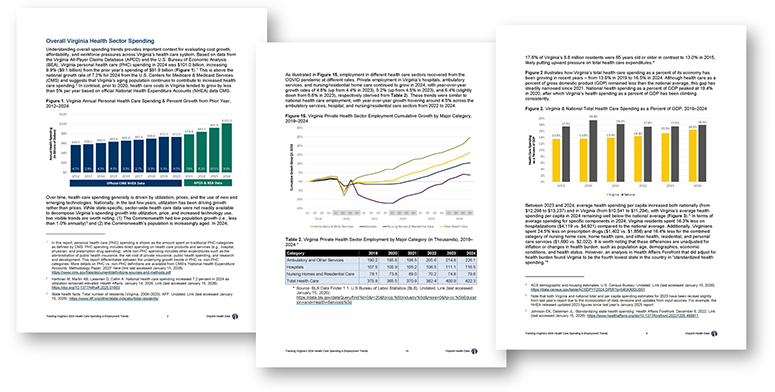
Figure 1. Reporting Featured in the 2024 Report Tracking Virginia's Health Care Spending & Employment Trends
The authors would like to thank the Virginia Hospital and Healthcare Association for their support of this work. Onpoint also would like to recognize the Virginia Health Information organization for their assistance in using the data provided from the Virginia All-Payer Claims Database. We extend additional thanks to Altarum for developing the methodologies used for much of the historical reporting on these health care trends in Virginia.
Explore More
- Indiana Health Prices Chatbot Recognized Nationally with NAHDO 2026 Innovation in Data Dissemination Award
- Staff Spotlight: Kate Davis, MBA, PMP - Client Services Manager
- New Onpoint Issue Brief: Calculating FFS Equivalents for Capitated Services
- Staff Spotlight: Jesse Drummond, PhD - Director of Data Analytics