Vermont & Onpoint Explore Ways to Reduce Spending on Prescription Drugs
August 2026 – As spending on prescription drugs continues to escalate – especially on heavily marketed and highly sought GLP-1 agonists like Ozempic and Wegovy – states are rapidly exploring how to bend the cost curve and keep drugs affordable for their residents.
Onpoint is proud to have contributed to this important work in Vermont by supporting the state’s Green Mountain Care Board (GMCB) and their Prescription Drug Affordability Program. Over the past two years, Onpoint, alongside Horvath Health Policy, has been providing analytic support and subject matter expertise to assist the GMCB’s efforts to create a framework for regulating the cost of prescription drugs in the state. Our analytics team has provided the GMCB with a series of reports that provide thorough insights into the challenges facing Vermont as well as potential options to reduce future spending for both generic and brand-name drugs. These reports, as well as a suite of supporting public-facing dashboards, are accessible via the GMCB website.
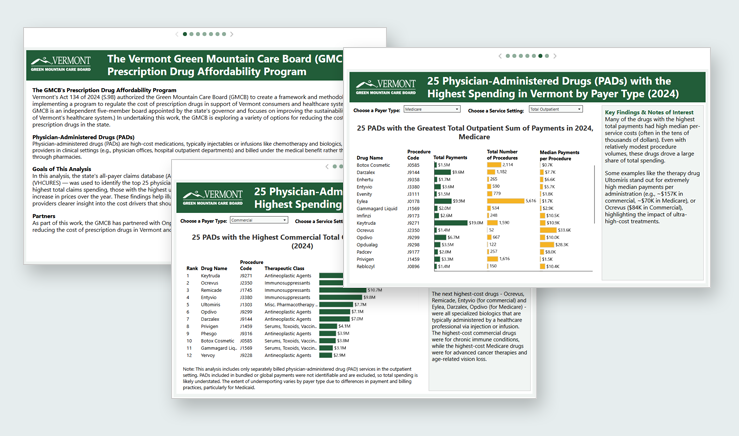
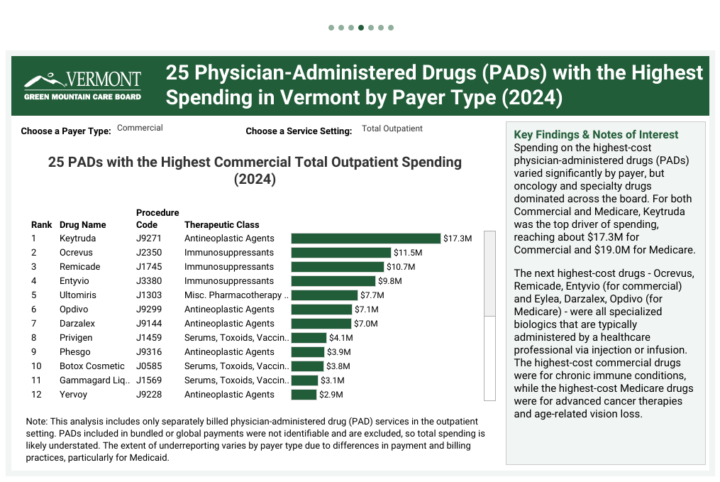
The most recent dashboard, which was published last month, provides insights into the cost and utilization of physician-administered drugs, or PADs. PADs include injectables like chemotherapy drugs and other biologics that are administered by a healthcare provider rather than picked up by patients at a retail pharmacy. Unlike most prescription drug spending, which is tracked by pharmacy claims, PADs are billed using medical claims.
Previous dashboards developed by Onpoint for the GMCB have provided information on the drugs with the highest spending and utilization in Vermont and outlined the potential financial impacts of two proposed approaches to reducing the growth of prescription drug spending: (1) the possible adoption of the Mark Cuban Cost Plus Drug Company as a primary supplier of generic medications in the state and (2) the extension of the Medicare Maximum Fair Price (MFP) program to the non-Medicare population. These dashboards also are available on the GMCB website.
This recent work was referenced in a June article by the National Academy of State Health Policy (NASHP) announcing an updated version of their model legislation enabling states to use the MFP as an upper payment limit for drug prices.
Created in 2022 as part of the federal Inflation Reduction Act, the MFP program gives the U.S. Centers for Medicare and Medicaid Services (CMS) the authority to negotiate prices directly with drug manufacturers for selected high-cost medications covered under Medicare Part D (as of 2026) and Part B (as of 2028). An initial slate of 10 drugs was selected for MFP implementation in 2026 and another 15 for implementation in 2027. (In January 2026, CMS announced an additional 15 drugs that will be subject to negotiation as part of the third cycle of the MFP program; prices for these drugs, set to go in effect in January 2028, will be announced later this year.)
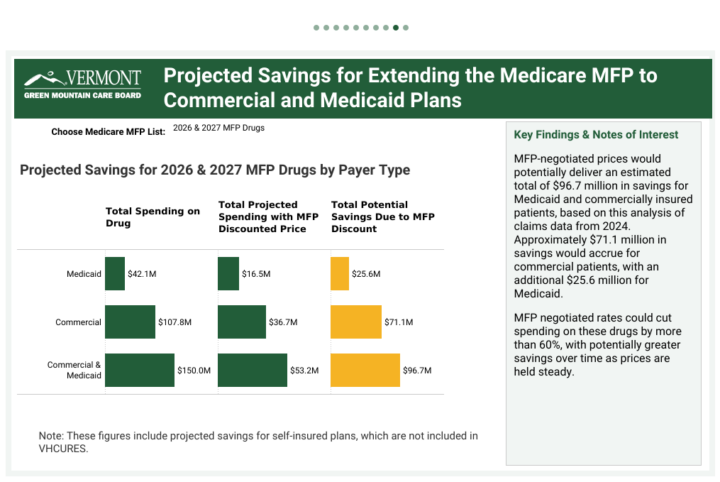
Using data from the state’s all-payer claims database (APCD) – the Vermont Health Care Uniform Reporting and Evaluation System (VHCURES) – Onpoint’s analysis used the most recent year of spending data available (2024) and found that the current and proposed MFP pricing would have saved Vermont residents with commercial health insurance $71.1 million if it had been applicable to prescriptions filled in 2024. The greatest potential savings were concentrated in GLP-1 agonists and specialty biologics like Stelara and Enbrel that primarily treat autoimmune and inflammatory conditions.
This project is a great example of how APCD data can be leveraged to drive policy change and guide high-level decision-making through complex analytics. Onpoint is grateful for the opportunity to partner with the GMCB and contribute to its important mission. To learn more about Vermont’s Prescription Drug Affordability Program, explore the GMCB website.